The Government of India has introduced a major change to your retirement savings framework. Effective June 29, 2026, the newly notified Employees’ Provident Funds (EPF) Scheme, 2026 officially replaced the decades-old EPF Scheme of 1952. This reform aligns the provident fund ecosystem with the Code on Social Security, 2020.
While the primary goal remains securing your retirement, the operational machinery has undergone a massive upgrade. The new rules change how you view your take-home pay, how you request partial withdrawals, and how contract workers receive safety nets.
We break down the top 5 changes in the new EPF rules that every salaried employee and employer must understand.
The Core Transition at a Glance
Before diving into the detailed changes, this rule change table captures how the structural foundation shifts between the two legal frameworks.
Rule Change Table
| Feature | Old EPF Scheme, 1952 | New EPF Scheme, 2026 |
| Governing Act | Employees’ Provident Funds Act, 1952 | Code on Social Security, 2020 |
| Wage Ceiling Limit | Hardcoded at ₹15,000 inside the text | Stated as “as notified by the Central Govt” |
| Mandatory Contribution Cap | 12% of basic salary up to the ceiling | Capped strictly at ₹1,800 per month unless agreed otherwise |
| Advance Claims | 13 cumbersome, fragmented reasons | 3 highly simplified umbrella categories |
| Contractor Liability | Shared or poorly monitored tracking | Direct legal liability on the Principal Employer |
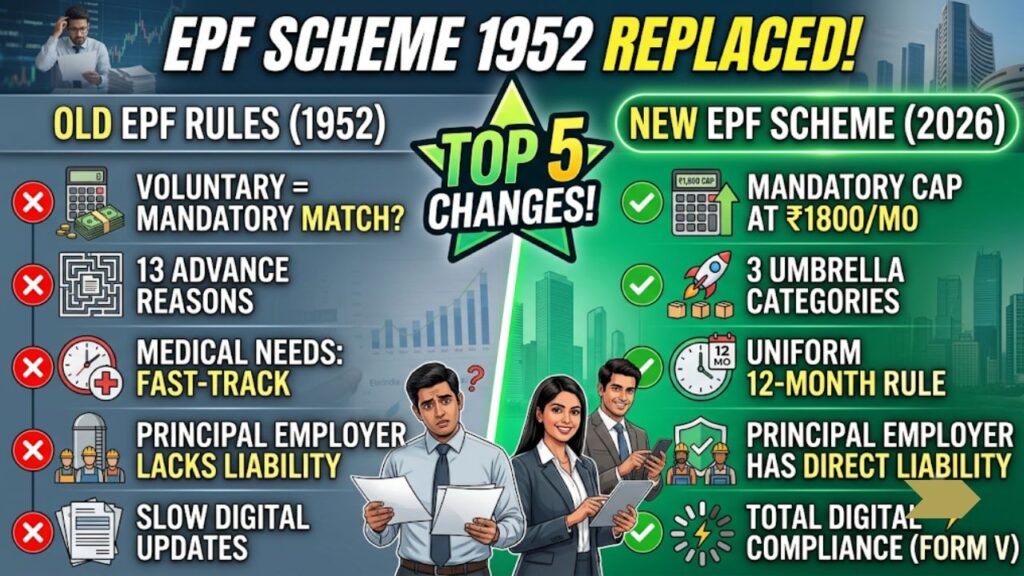
Top 5 Changes in the New EPF Rules (2026)
1. The ₹1,800 Contribution Clarification (Voluntary vs. Mandatory)
The new scheme draws a strict legal line between mandatory and voluntary PF savings. The statutory wage ceiling remains at ₹15,000 per month. Therefore, the mandatory monthly contribution for both the employer and the employee stays at ₹1,800 (12% of ₹15,000).
Under the old 1952 framework, many companies calculated the 12% contribution on an employee’s full basic salary automatically, even if it exceeded ₹15,000. The 2026 rule formally clarifies that employers possess no legal obligation to match an employee’s voluntary PF contributions above the ₹1,800 threshold.
- Impact on Salary: If your employer chooses to restrict their contribution to the statutory minimum of ₹1,800, your monthly take-home salary might increase.
- Impact on Savings: Dropping your monthly PF investment to the bare minimum will shrink your compounding growth and reduce your final retirement corpus over time.
2. Radical Simplification of Advance Withdrawal Categories
Previously, withdrawing money early from your PF account required navigating 13 separate, complex rule segments. Employees struggled with specific forms for medical emergencies, marriages, or home alterations.
The EPF Scheme 2026 completely replaces that messy checklist. It groups all partial withdrawals into three simple categories:
- Essential Needs: Covers personal or family illness, higher education, and marriage expenses.
- Housing Needs: Combines home purchase, land buying, house construction, home loan repayments, and structural renovations into one head.
- Special Circumstances: Includes natural disasters, sudden lockouts, or exceptional situations declared by the Central Board of Trustees.
3. Uniform 12-Month Membership Rule for All Advances
The old scheme allowed immediate, fast-track withdrawals for medical emergencies without any minimum service limit. The 2026 rules introduce a uniform eligibility test across all withdrawal categories.
Members must now complete 12 months of total membership in the fund before unlocking any early advance, including medical requests. On the positive side, the formula now lets you access up to 100% of your eligible balance (subject to leaving a minimum 25% floor balance behind) once you cross that one-year mark.
4. Direct Accountability for Principal Employers On Contract Labor
To fix widespread evasion of social security for casual and contract labor, the new framework shifts ultimate legal responsibility to the Principal Employer.
If a third-party vendor or subcontractor fails to deposit PF contributions for their workers, the main company using their labor inherits the liability. Principal employers must ensure strict digital tracking of all contract workers via their Universal Account Numbers (UAN).
5. Stricter Governance and Digital Form V Filings
The 2026 scheme digitizes the compliance cycle entirely. To transition smoothly into the new regime, the government mandates all registered companies to file a consolidated digital return called Form V within 15 days of operationalization. This return registers and links the Aadhaar, PAN, and UAN details of every single active employee directly with the EPFO portal. Furthermore, exempted corporate PF trusts face aggressive new annual audit regulations and tougher rules for renewal.
Summary of Key Highlights
This table compresses the vital operational metrics that define your interaction with the updated EPFO system.
Key Highlights Table
| Metric / Policy | Standard Condition Under New Rules |
| Standard Contribution Rate | 12% of wages for both employee and employer |
| Statutory Monthly Ceiling | ₹15,000 |
| Maximum Compulsory PF Outlay | ₹1,800 per month per side |
| Minimum Lock-In Floor Balance | 25% of the total balance must stay in the fund |
| Maximum Advance Limit | Up to 75% of your combined account balance |
| Continuous Service Rule for Tax | Employer share withdrawals before 5 years remain taxable |
Important Timeline and Support
The transition window requires swift updates from corporate payroll desks and awareness from employees. Use the calendar milestones below to ensure your company stays fully compliant.
Important Dates Table
| Date / Phase | Milestone Event |
| May 29, 2026 | Gazette Notification S.O. 2702(E) confirms the ₹15,000 wage ceiling |
| June 29, 2026 | The EPF Scheme, 2026 officially takes effect, replacing the 1952 Scheme |
| July 14, 2026 | Final legal deadline for employers to file the mandatory Form V return |
| Rest of 2026 | Execution window for the supportive VISHWAS and AMNESTY resolution schemes |
Government Support and Helpdesk
If you experience tech hitches with your online e-passbook, UAN links, or new advance applications, utilize the official channels below.
Helpline Number Table
| Support Channel | Official Contact Detail |
| EPFO National Toll-Free Helpline | 1800-118-005 |
| Umang App Help Center | Accessible via Umang mobile application |
| Official Grievance Portal | EPFiGMS Portal |
Official Government References
Always rely strictly on legitimate government publications for compliance matters. The new scheme builds upon these key statutory foundations:
Official References Table
| Document Name | Issuing Authority | Purpose |
| The Code on Social Security, 2020 | Ministry of Law and Justice, India | The parent legislation replacing legacy labor laws |
| Gazette Notification (June 29, 2026) | Ministry of Labour and Employment | Officially enforces the EPF Scheme, 2026 |
| Gazette Notification S.O. 2702(E) | Central Government of India | Ratifies the statutory wage limits and caps |
Conclusion
The EPF Scheme, 2026 does not cut your hard-earned benefits. Instead, it legalizes the distinction between voluntary financial top-ups and statutory company obligations. Talk to your company HR department immediately to confirm if they plan to change your CTC structure or if they will continue calculating your PF on your actual basic salary. Keeping an eye on these modern settings ensures your retirement plan stays robust and fully funded.