India stands on the edge of a massive industrial boom. The Union Cabinet recently approved two historic initiatives to supercharge the country’s technology economy. The government cleared Semicon 2.0 and the Mobile Phone Manufacturing Scheme (MPMS). Together, these programs carry a massive financial outlay of ₹1.9 lakh crore.
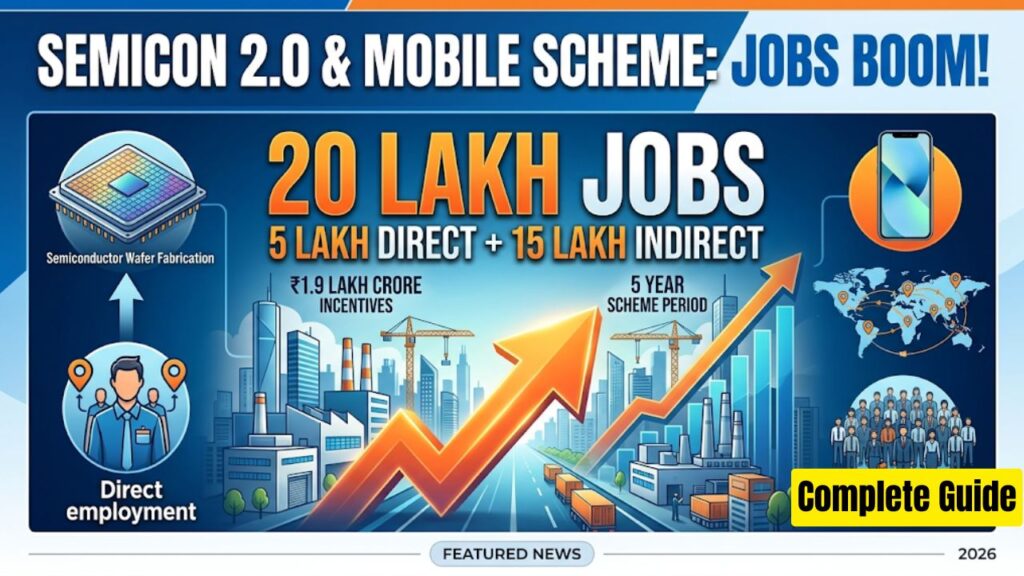
This giant policy push aims to transform India from a simple device assembler into a dominant global hub for technology design, chip fabrication, and advanced research. Most importantly, this massive upgrade will spark an unprecedented employment wave across the nation, creating up to 20 lakh total jobs.
The Massive Employment Wave: 20 Lakh Opportunities
The sheer scale of this electronic revolution will completely change India’s job market. The government expects these schemes to generate massive employment over the next five years.
- Direct Employment (5 Lakh Jobs): Factories, fabrication units, and clean rooms will directly hire high-skilled and semi-skilled workers. These roles include chip design engineers, plant operators, assembly technicians, and quality control specialists.
- Indirect Employment (15 Lakh Jobs): The growth of massive manufacturing plants creates a huge ripple effect across the economy. These indirect roles will open up in logistics, supply chain management, chemical transport, packaging industries, facility maintenance, and catering services.
Breaking Down the ₹1.9 Lakh Crore Mega Package
The comprehensive package splits its ₹1.9 lakh crore budget into two distinct pathways to maximize the technological impact:
1. Semicon India Programme 2.0 (Budget: ₹1,27,500 Crore)
Semicon 2.0 expands the foundations laid during the initial phase of the India Semiconductor Mission. This program focuses heavily on six critical core pillars:
- Chip and Intellectual Property (IP) Design: Supporting engineers to create indigenous software designs.
- Equipment and Materials: Incentivizing the local production of complex manufacturing machines, specialized gases, and essential chemicals.
- Fabrication Facilities: Attracting world-class mega-factories to manufacture silicon wafers, compound semiconductors, and display units.
- Advanced Assembly and Packaging: Strengthening local Assembly, Testing, Marking, and Packaging (ATMP) setups.
- Research and Development (R&D): Collaborating with domestic and global institutions to explore smaller process nodes.
- Talent Creation: Reforming university curricula to train an industry-ready workforce in cleanroom technologies.
2. Mobile Phone Manufacturing Scheme (Budget: ₹62,500 Crore)
The MPMS officially succeeds the highly successful Production Linked Incentive (PLI) scheme that ended in March 2026. While the old PLI scheme established massive volume assembly lines, MPMS shifts the focus toward deep local value addition.
The new scheme runs from Financial Year 2026-27 to 2030-31. It provides a baseline incentive ranging between 2.25% and 5% on the sales of locally made mobile phones. To deepen the local ecosystem, it rewards companies with two unique bonuses:
- Local Sourcing Bonus: An extra incentive of up to 1.5% for manufacturers who purchase their key components and sub-assemblies from within India.
- Indian Brand Design Bonus: A special 3% incentive for domestic brands that invest heavily in local research, development, and proprietary product design.
Moving From Simple Assembly to Deep Value Addition
Over the last decade, India’s electronics sector grew seven-fold. Today, local factories manufacture an incredible 99.2% of all mobile phones sold in the domestic market. Smartphones have actually overtaken traditional goods like refined petroleum to become India’s single largest export product category.
However, simple assembly only captures a small fraction of a smartphone’s total economic value. The real money lies in chip creation, component manufacturing, and intellectual property. Semicon 2.0 and MPMS aggressively target these high-value areas. By producing local sub-assemblies and fabricating chips right here on Indian soil, the nation will retain the vast majority of economic profits within its borders.
Key Highlights of the Government Package
The table below outlines the core components of this landmark manufacturing push:
| Feature / Detail | Specification |
| Total Combined Budgetary Outlay | ₹1,90,000 Crore (approx. $22 Billion USD) |
| Semicon 2.0 Allocation | ₹1,27,500 Crore |
| Mobile Phone Scheme (MPMS) Allocation | ₹62,500 Crore |
| MPMS Operational Tenure | FY 2026-27 to FY 2030-31 (5 Years) |
| Expected Direct Employment | 5,000,000 (5 Lakh) Direct Jobs |
| Expected Indirect Employment | 1,500,000 (15 Lakh) Indirect Jobs |
| Projected Mobile Production Value | Around ₹39 Lakh Crore over the scheme period |
| Target Domestic Chip Market Value | $200 Billion by the year 2035 |
Important Timeline & Dates
Here is the Important Timeline & Dates section formatted into a clean, easy-to-scan table:
| Target Date / Period | Milestone Event | Key Details |
| July 15, 2026 | Cabinet Approval Granted | The Union Cabinet officially clears the ₹1.9 lakh crore combined budget for Semicon 2.0 and MPMS. |
| Late July 2026 | Administrative Notification Release | The government will officially issue detailed policy guidelines and administrative rules within two weeks of approval. |
| Q3 2026 | Application Windows Open | Global and domestic manufacturers can officially submit project proposals for fabrications, assembly units, and component lines. |
| FY 2026-27 | Scheme Implementation & Baseline Year | The five-year operational period for production-linked payouts officially begins. |
Government Official References
You can track official notifications, application portals, and ministry updates through these direct channels:
| Organization / Portal Name | Official Reference / Web Link |
| Press Information Bureau (PIB) | pib.gov.in |
| Ministry of Electronics and Information Technology | meity.gov.in |
| India Semiconductor Mission (ISM) Portal | ism.gov.in |
| Digital India Official Website | digitalindia.gov.in |
Helpline and Support Desk Details
Businesses, startups, and academic institutions looking to participate in Semicon 2.0 or MPMS can contact the official support helplines:
| Department Desk | Contact Purpose | Dedicated Helpline / Email |
| ISM Scheme Support Desk | Fabrications, ATMP, and Chip Design Projects | +91-11-24301748 / support-ism@gov.in |
| MeitY Electronics Cell | Mobile Manufacturing (MPMS) and Component Incentives | +91-11-24363114 / el-meity@gov.in |
| PIB Media Cell | Public Press Inquiries and Official Documentation Releases | +91-11-23383648 / pib-media@nic.in |
| Digital India Help Desk | General Startup and Tech Infrastructure Queries | 1800-111-400 / helpdesk@digitalindia.gov.in |
Final Thoughts
The launch of Semicon 2.0 and the Mobile Phone Manufacturing Scheme marks a monumental milestone for India. By backing this industrial push with a colossal ₹1.9 lakh crore fund, the government addresses the core needs of the modern electronics supply chain.
This strategy will quickly reduce India’s reliance on imported components, create an indigenous intellectual property base, and protect the nation against global supply disruptions. Most importantly, the generation of 20 lakh jobs will secure livelihoods, uplift the domestic workforce, and fuel India’s economic engine for decades to come.