The Indian government continues its aggressive push toward clean and sustainable energy. Prime Minister Narendra Modi chaired the Union Cabinet meeting that approved the Pradhan Mantri Surya Sarovar Yojana (PM-SSY). This ambitious national scheme aims to transform India’s massive water bodies into giant clean energy hubs. The government seeks to build large-scale Floating Solar Photovoltaic (FSPV) power plants across lakes, reservoirs, canals, and industrial ponds.
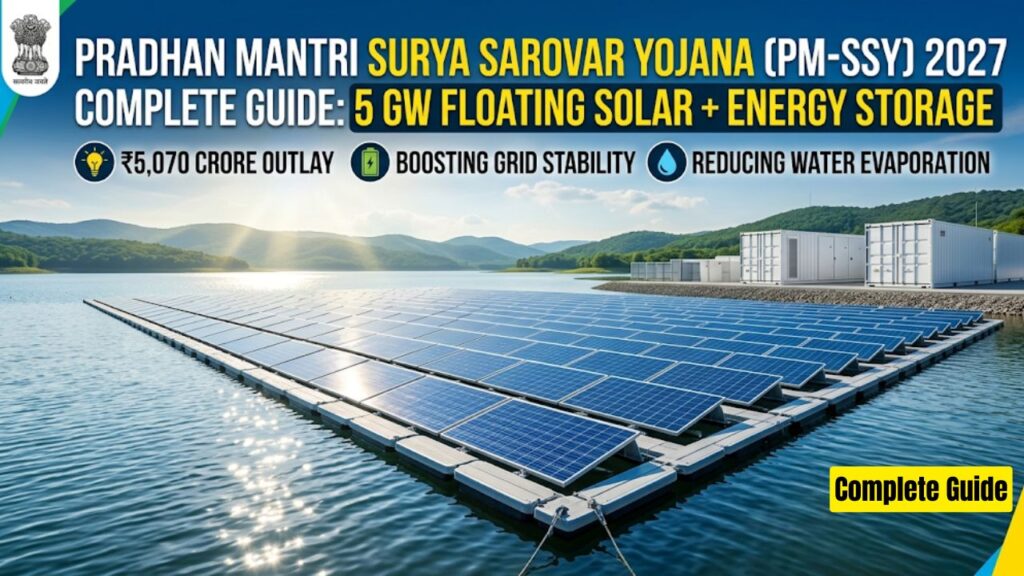
Land acquisition often creates major bottlenecks for large ground-mounted solar power plants. PM-SSY solves this challenge directly by placing solar panels on top of existing water surfaces. By combining floating solar technology with integrated energy storage systems, the scheme guarantees clean and stable electricity generation for the national grid.
What is Pradhan Mantri Surya Sarovar Yojana (PM-SSY)?
The Pradhan Mantri Surya Sarovar Yojana (PM-SSY) is a dedicated national green energy scheme. The government designed PM-SSY to develop 5,000 MW (5 GW) of floating solar power capacity across India. This initiative expands India’s floating solar capacity by more than seven times from its present level of about 700 MW.
Every floating solar power project under PM-SSY must include a co-located Energy Storage System (ESS). The government mandates a minimum storage capacity of two hours for each project. Across the entire 5,000 MW target, the scheme creates at least 10,000 MWh of energy storage capacity. This battery integration allows power companies to store solar energy during peak daylight hours and release electricity when public power demand surges.
Key Highlights of PM-SSY 2027
The following summary table outlines the core facts, financial details, and targets of the Pradhan Mantri Surya Sarovar Yojana:
| Feature Parameter | Official Details |
| Scheme Name | Pradhan Mantri Surya Sarovar Yojana (PM-SSY) |
| Approved Outlay | ₹5,070 Crore |
| Target Solar Capacity | 5,000 MW (5 GW) Floating Solar Photovoltaic (FSPV) |
| Storage Requirement | Minimum 2-hour Energy Storage System (10,000 MWh total) |
| Central Financial Assistance (CFA) | ₹1 Crore per MW after project commissioning |
| Feasibility Grant | Up to ₹50 Lakh per project for pre-construction studies |
| Sanction Period | Financial Year 2026-27 to Financial Year 2030-31 |
| Disbursement Period | Financial Year 2026-27 up to Financial Year 2032-33 |
| Geographic Coverage | All States and Union Territories across India |
| Implementing Ministry | Ministry of New and Renewable Energy (MNRE) |
Key Objectives of PM-SSY
The government targets several crucial economic and environmental goals through PM-SSY:
- Utilize Water Bodies Productively: Project developers place solar modules over existing reservoirs, canals, lakes, and industrial ponds.
- Eliminate Land Disputes: Floating solar plants avoid expensive agricultural or forest land purchases entirely.
- Strengthen Grid Stability: Mandatory energy storage systems provide dispatchable power during evening peak hours.
- Boost Domestic Manufacturing: The scheme promotes local production of floaters, solar modules, battery storage, and anchoring structures under Aatmanirbhar Bharat.
- Reduce Water Evaporation: Covering water surfaces with solar panels reduces evaporation losses and conserves fresh water for irrigation and drinking.
How Floating Solar Photovoltaic (FSPV) Technology Works
Floating solar technology positions photovoltaic panels on specially engineered floating platforms. Specialized mooring and anchoring systems hold these floating structures securely in place on water reservoirs. Underwater or floating cables then transmit the generated direct current (DC) electricity to power inverters on the bank.
Floating solar panels operate more efficiently than ground-mounted panels. The underlying water provides a natural cooling effect. Lower operating temperatures increase solar panel output and overall energy yields. Furthermore, water surfaces generate significantly less ambient dust. Less dust accumulation lowers cleaning frequency, cuts maintenance costs, and maintains high performance levels over time.
Financial Outlay and Central Financial Assistance (CFA)
The Union Cabinet allocated a total financial budget of ₹5,070 crore for the PM-SSY scheme. The central government structures this outlay to reduce financial risk for project developers and state utilities:
- Commissioning Support (₹1 Crore / MW): The central government provides Central Financial Assistance (CFA) of ₹1 crore for every megawatt of floating solar power. The government releases this financial aid directly to eligible developers after successful plant commissioning.
- Feasibility Study Support (Up to ₹50 Lakh / Project): Floating solar installations require detailed hydrographic and geological mapping. The government offers up to ₹50 lakh per project to conduct pre-construction assessments. These studies cover bathymetry surveys, water depth checks, environmental impact studies, and structural anchoring assessments.
Implementation Timeline and Important Dates
The government executes the Pradhan Mantri Surya Sarovar Yojana across a structured multi-year timeline. The table below lists all key project milestones:
| Event Milestone | Schedule / Timeline |
| Cabinet Approval Date | July 31, 2026 |
| Scheme Launch Year | Financial Year 2026-27 |
| Project Sanction Window | Financial Year 2026-27 to Financial Year 2030-31 |
| Financial Disbursement Window | Financial Year 2026-27 to Financial Year 2032-33 |
| Target Completion Window | March 2033 |
India’s Floating Solar Potential (NISE Assessment)
The National Institute of Solar Energy (NISE) recently completed a comprehensive resource mapping study across India. The study estimates that India possesses nearly 102.18 GWp (Gigawatt-peak) of floating solar power potential. India’s vast network of hydroelectric dams, irrigation reservoirs, man-made lakes, and industrial ponds provides ideal conditions for floating solar expansion.
The initial 5,000 MW target under PM-SSY unlocks roughly 5% of this total nationwide potential. All States and Union Territories will participate in this scheme, opening vast clean power opportunities in land-constrained states.
Environmental, Economic, and Social Benefits
PM-SSY delivers significant benefits across multiple sectors of the Indian economy:
- Massive Carbon Reduction: The 5,000 MW floating solar capacity cuts carbon dioxide (CO₂) emissions by approximately 10 million tonnes every single year.
- Job Creation: The scheme generates between 16,000 and 17,000 full-time equivalent jobs across manufacturing, engineering, float installation, logistics, and maintenance.
- Water Conservation: Solar panels block direct sunlight, decreasing water evaporation rate in reservoir basins. Saved water directly supports local farming, drinking supply, and industrial needs.
- Energy Storage Integration: Mandatory 2-hour battery systems allow grid managers to dispatch renewable power during demand spikes, stabilizing power lines.
- Local Industrial Growth: The policy creates high demand for locally manufactured solar cells, floating rafts, anchors, and battery cells under Aatmanirbhar Bharat.
Selection Process for Floating Solar Developers
The central government and state agencies will select power producers through competitive bidding processes:
- Site Identification: State governments and water resource departments identify eligible water reservoirs and ponds.
- Feasibility Mapping: Developers or state agencies perform bathymetric and environmental surveys using government study grants.
- Tariff-Based Bids: Implementing agencies invite transparent, tariff-based competitive tenders from solar energy companies.
- Project Execution: Selected companies construct the floating solar array alongside the required battery storage facility.
- CFA Release: The government releases ₹1 crore per MW of Central Financial Assistance directly to developers after commissioning.
Government Official References
For official press updates and policy guidelines, consult these official portals:
| Reference Portal / Source | Official Web Link |
| Prime Minister’s Office (PMINDIA News) | PMINDIA Release |
| Ministry of Information & Broadcasting (NewsOnAir) | NewsOnAir Portal |
| Times of India Business Report | Times of India Article |
| Ministry of New & Renewable Energy (MNRE) | MNRE Official Website |
Helpline and Contact Information
Stakeholders, energy developers, and citizens can reach relevant authorities through these official contact details:
| Support Channel | Official Contact Details |
| Scheme Name | Pradhan Mantri Surya Sarovar Yojana (PM-SSY) |
| Nodal Ministry | Ministry of New and Renewable Energy (MNRE) |
| MNRE National Toll-Free Helpline | 1800-180-3333 / 155333 |
| MNRE Official Email Support | support-mnre@gov.in |
| Headquarters Address | Atal Akshay Urja Bhawan, CGO Complex, Lodhi Road, New Delhi – 110003 |
Conclusion
The Pradhan Mantri Surya Sarovar Yojana (PM-SSY) marks a major transformation in India’s renewable energy roadmap. By converting existing water bodies into productive green energy centers, the government addresses land scarcity while generating 5,000 MW of clean floating solar power. The mandatory inclusion of energy storage systems ensures grid reliability and strengthens power security across India. Furthermore, the ₹5,070 crore outlay supports domestic manufacturing, conserves vital water resources, and creates thousands of job opportunities for Indian youth.