The Government of Assam continues to empower economically weaker families through the flagship Orunodoi 3.0 Scheme. Under this social welfare initiative, the state government provides direct monthly financial assistance to eligible women. The Assam government updated the Orunodoi 3.0 Beneficiary List 2026-27 on its official web portal.
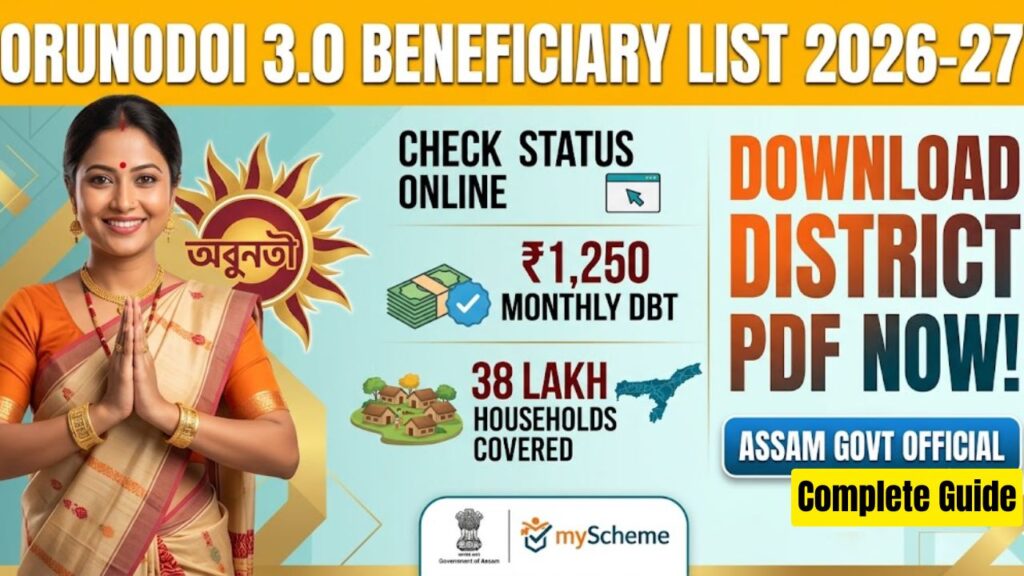
Citizens can now check their application status online. You can also download the district-wise PDF list directly from the official Assam government portal. This detailed guide explains the eligibility criteria, required documents, step-by-step download procedures, helpline numbers, and important links.
Key Highlights of Orunodoi 3.0 Scheme
The table below summarizes the core features of the Orunodoi 3.0 scheme:
| Field | Detail |
| Scheme Name | Orunodoi Scheme (Arunodoi Asoni) |
| Current Phase | Orunodoi 3.0 |
| Launching Authority | Government of Assam |
| Nodal Department | Finance Department, Assam |
| Primary Beneficiaries | Women heading low-income households |
| Monthly Assistance | ₹1,250 per month |
| Transfer Method | Direct Benefit Transfer (DBT) to Aadhaar-linked bank accounts |
| Target Coverage | Over 25 Lakh to 38 Lakh eligible households |
| Official Portal | orunodoi.assam.gov.in / sewasetu.assam.gov.in |
Objectives of Orunodoi 3.0
The Assam government launched the Orunodoi scheme to improve financial independence among women. The scheme aims to achieve several primary goals:
- Financial Security: The state provides ₹1,250 every month to help poor households buy basic essentials, medicines, and groceries.
- Women Empowerment: The government names the female head of the family as the main beneficiary.
- Direct Benefit Delivery: The administration eliminates middlemen by transferring funds directly to bank accounts.
- Poverty Alleviation: The steady monthly support helps families meet daily nutritional and health needs.
Eligibility Criteria for Applicants
Applicants must satisfy specific eligibility conditions to receive benefits under Orunodoi 3.0. The selection committee prioritizes vulnerable groups.
- State Residency: The applicant must hold permanent residence in Assam.
- Female Household Head: A woman must head the family or act as the nominated beneficiary.
- Income Limit: The annual household income must not exceed ₹2 Lakh per annum.
- Bank Account Requirements: The beneficiary must possess an active, Aadhaar-linked bank account.
- Priority Groups: The government grants immediate priority to:
- Widows and divorced or separated women.
- Unmarried women above 45 years of age.
- Specially-abled persons (Divyangjan).
- Families with members suffering from severe diseases like HIV, Thalassemia, or Autism.
- Antyodaya Anna Yojana (AAY) cardholders.
- Destitute women living on alms or in old age homes.
Exclusion Criteria (Who Cannot Apply?)
The Assam government excludes high-income households from this financial aid scheme. You cannot claim benefits if your family meets any of the following points:
- Any household member works as a regular government employee or pensioner.
- The family owns a four-wheeler vehicle (car, tractor, or heavy machinery).
- The family possesses more than 15 Bighas of agricultural land.
- Any family member practices as a licensed doctor, engineer, lawyer, or architect.
- The household pays income tax regularly.
Required Documents for Application & Verification
Applicants must submit valid personal documents to get listed on the official beneficiary list. Ensure you have clear copies of these records:
- Aadhaar Card (mandatory for DBT seeding)
- Permanent Residence Certificate (Voter ID or Domicile proof)
- Ration Card / AAY Card Copy
- Bank Account Passbook showing IFSC code and account details
- Income Certificate issued by local authority
- Disability Certificate (if applicable)
- Recent Passport-size Photographs
- Active Mobile Number
How to Download Orunodoi 3.0 District-Wise Beneficiary List PDF
Citizens can view and download the official district PDF files through the state portal. Follow these operational steps to locate your name:
1. Visit the Official Portal:
Open your browser and navigate to the official Assam Orunodoi portal (orunodoi.assam.gov.in or sewasetu.assam.gov.in).
2. Navigate to District List:
Click on the Beneficiary List / District List option on the homepage navigation menu.
3. Select Your District:
Choose your specific district from the dropdown list containing all 35 districts of Assam. Select your relevant LAC (Legislative Assembly Constituency), Gram Panchayat, or Urban Local Body.
4. Download PDF File:
Click the Download PDF button next to your Gram Panchayat or ward name. The browser saves the complete list to your local storage.
5. Search Your Name:
Open the downloaded PDF file. Press Ctrl + F on your computer or use the search icon on your phone to search your name, Aadhaar number, or application ID.
How to Check Orunodoi 3.0 Application Status Online
If you want to verify your individual payment or approval status, follow this simple process:
- Open the official Orunodoi status website.
- Click on the Check Beneficiary Status button.
- Enter your Aadhaar Number or Registered Mobile Number.
- Select your District name from the dropdown menu.
- Click Submit to view your application status and monthly DBT payment history on the screen.
Important Dates Table
Track key events and distribution schedules for the Orunodoi 3.0 cycle:
| Event / Activity | Date / Timeline |
| Orunodoi 3.0 Scheme Launch | October 7, 2025 |
| Field Verification Drives | Conducted across all districts regularly |
| Publication of District Beneficiary Lists | Updated periodically online |
| Monthly Disbursement Date | 10th of every month |
| Status Checking Availability | 24/7 on the official web portal |
Government Official References Table
Use these verified government portals to read official notifications, verify status, and access genuine scheme guidelines:
| Reference Source | Description / Purpose | Official URL / Details |
| Orunodoi Official Portal | District list download, payment status, guidelines | orunodoi.assam.gov.in |
| Sewa Setu Assam | Citizen services and welfare status check | sewasetu.assam.gov.in |
| myScheme National Portal | Scheme criteria and eligibility guide | myscheme.gov.in/schemes/aos |
| Finance Dept, Assam | Nodal government policy authority | finance.assam.gov.in |
Helpline Number & Support Table
If you encounter payment failures, rejection issues, or name errors in the beneficiary list, contact the dedicated helpdesk immediately:
| Support Channel | Contact Details | Operating Hours |
| Orunodoi Toll-Free Helpline | 1800-202-6256 | Working days (10:00 AM – 6:00 PM) |
| State Public Grievance Helpline | 0361-2381511 / 91810-14888 | Standard office working hours |
| Emergency Support Number | 112 | 24/7 Availability |
| Assam Finance Email Support | samirksinha@gov.in | Email response on working days |
| Grievance Redressal | District Magistrate Office / GP Office | District level offices |
What to Do If Your Name Is Missing from the List?
If your name does not appear in the latest district PDF file, follow these corrective actions:
- Check Aadhaar Seeding: Visit your bank branch and link your Aadhaar card to your bank account.
- Verify Mobile Number: Ensure your registered mobile number links properly with your application.
- Submit Grievance: File an inquiry at your local Gram Panchayat (GP) or Urban Local Body (ULB) office.
- Call Helpdesk: Dial
1800-202-6256to raise an official ticket regarding missing beneficiary status.
Frequently Asked Questions (FAQs)
What is the monthly assistance under Orunodoi 3.0?
The Assam government transfers ₹1,250 directly to the beneficiary’s bank account every month.
On which date does the government transfer the Orunodoi payment?
The government usually credits the monthly payment on the 10th day of every month.
Who gets priority under the Orunodoi scheme?
Widows, divorced women, disabled individuals, unmarried women above 45, and poor households receive top priority.
How do I link my bank account with Aadhaar for DBT?
Visit your bank branch, submit a copy of your Aadhaar card, and request Aadhaar-seeding for Direct Benefit Transfer (DBT).